Beata Walks In Fields of Wine – Almost Time For Harvest

1184867_513440852057952_28365550_n


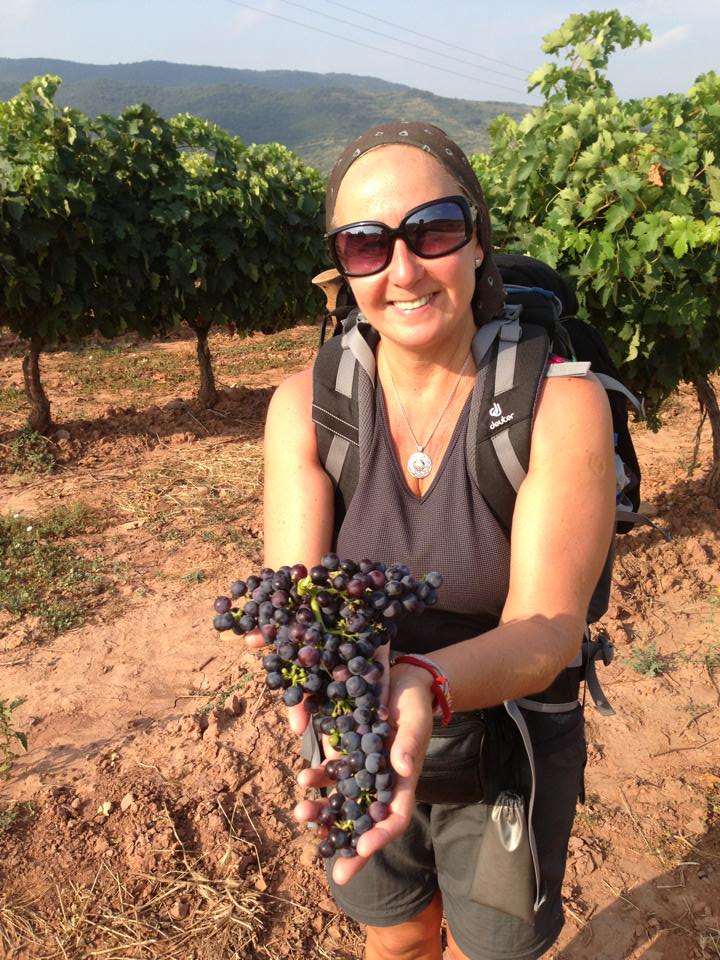
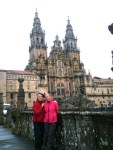
End of Summer Sunshine and SMILES in Fields of Wine!  It is almost time for harvest and you can see the beauty of nature’s hard work bringing smiles to all.  Beata Moritz is enjoying another incredibly special Camino and you can see her heart and hands are full of some very wonderful  and memorable experiences.

Thank you Beata for sharing a fantastic picture and memory of your Camino Journey.  I look forward to celebrating with you over a glass of wine in Santiago de Compostela and to hearing of your Camino ADVENTURES!


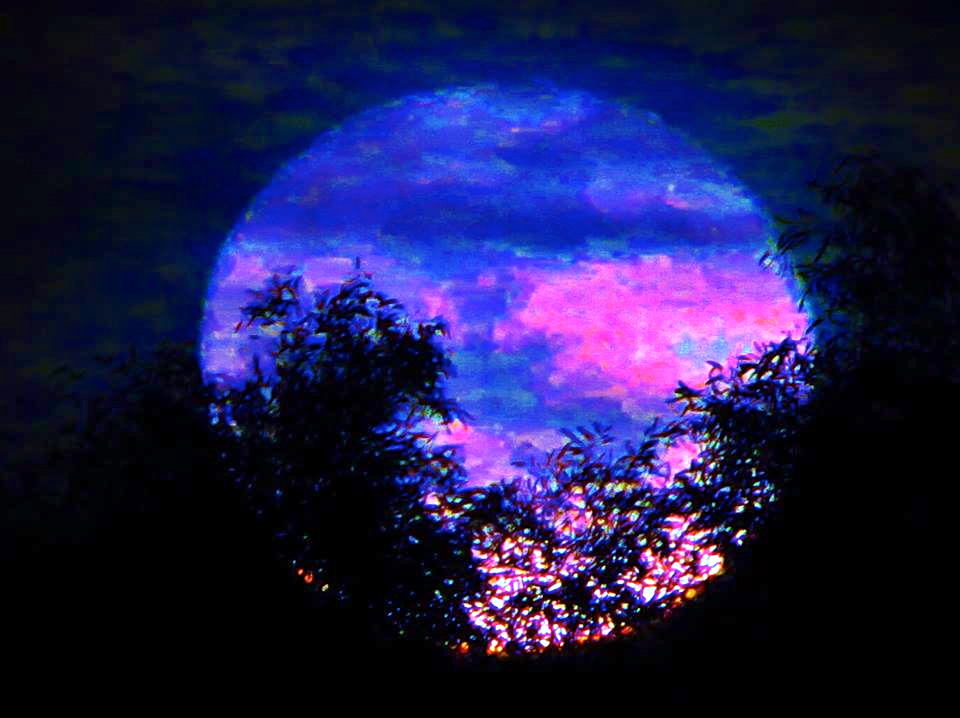
BLUE MOON – Have Fun Wishing On The Stars & Moon Tonight

1150931_620660261299304_1249836107_n

There is something inspiring at witnessing the nights sky and a FULL MOON shining on us brightly.  You can feel the magic of the ages and a connection with Mother Nature that comes to life during this very special time.  Enjoy today and the BLUE MOON as it blesses us – have fun looking up at the stars and enjoy some time in gratitude for all the blessings in your life and those that are now unfolding. There is something extra special about making  your wishes on the stars and MOON Tonight!

There are two definitions of blue moons.

Tonight’s blue moon is an extra summer moon, which is the third moon of four in the season that started on the June solstice. In most seasons, there are three full moons, but once in a while there are four moons. The extra moon is called a blue moon. Tonight’s full moon is also called a Full Sturgeon Moon, the Full Red Moon, the Green Corn Moon and the Grain Moon.

“A blue moon is also defined as the second of two full moons within any given calendar month and is a rare occurrence; hence the phrase “once in a blue moon” which indicates the rarity of an event. All calendar months, aside from February, have 30 or 31 days, resulting in the occasional two full moons within a single month. Under this meaning of the ‘blue moon’, the last blue moon was on Aug, 31, 2012. The next ‘blue moon’ will not occur until July 2015.

The name of the event comes from the colors the moon takes on from time to time due to different conditions. After volcanic activity or forest fires, the moon can appear to take on a bluish or sometimes lavender coloration. This is because of soot and ash particles deposited high up into the Earth’s atmosphere.

A rare ‘super’ supermoon, a huge perigee moon, occurred on June 22 this year, The moon appeared to be bigger than the average full moon as it will be lined up with the sun perfectly so that the moon will appear to be brighter and bigger.

A “perigee” full moon means that it’s orbit is closes to the center of Earth in a month. Full moons do no necessarily happen during a perigee but when it does, it means the sun, earth and moon align. Another super moon like this will not be seen until August 2014.” – Christiantoday.com

Thank you Mark Stanley – for your beautiful picture and facebook post:

Cave of Altamira – Camino Norte

images-4

The Camino encourages a Spirit of Discovery.  Experiencing any of the Camino trails to Santiago de Compostela one is immersed in culture, history and traditions that leads us on a continued journey of discovery.  It is exciting and magical to learn more whether your pilgrimage travel interest includes history, art, architecture, gastronomy, festivals, wine or more you will enjoy many of your own new discoveries while Celebrating the Camino Spirit!

“In 1879, amateur archaeologist Marcelino Sanz de Sautuola was led by his eight year-old daughter María to discover the cave’s drawings. The cave was excavated by Sautuola and archaeologist Juan Vilanova y Piera from the University of Madrid, resulting in a much acclaimed publication in 1880 which interpreted the paintings as Paleolithic in origin. The French specialists, led by Gabriel de Mortillet andEmile Cartailhac, were particularly adamant in rejecting the hypothesis of Sautuola and Piera, and their findings were loudly ridiculed at the 1880 Prehistorical Congress in Lisbon. Due to the supreme artistic quality, and the exceptional state of conservation of the paintings, Sautuola was even accused of forgery. A fellow countryman maintained that the paintings had been produced by a contemporary artist, on Sautuola’s orders.”

“Altamira (Spanish for ‘high views’) is a cave in Spain famous for its Upper Paleolithic cave paintings featuring drawings and polychrome rock paintings of wild mammals and human hands.

Its special relevance comes from the fact that it was the first cave in which prehistoric cave paintings were discovered. When the discovery was first made public in 1880, it led to a bitter public controversy between experts which continued into the early 20th century, as many of them did not believe prehistoric man had the intellectual capacity to produce any kind of artistic expression. The acknowledgement of the authenticity of the paintings, which finally came in 1902, changed forever the perception of prehistoric human beings.

It is located near the town of Santillana del Mar in CantabriaSpain, 30 km west of the city ofSantander. The cave with its paintings has been declared a World Heritage Site by UNESCO.

The cave is approximately 300 meters long and consists of a series of twisting passages and chambers. The main passage varies from two to six meters in height. The cave was formed through collapses following early karstic phenomena in the calcerous rock of Mount Vispieres.

Archaeological excavations in the cave floor found rich deposits of artifacts from the UpperSolutrean (c. 18,500 years ago) and Lower Magdalenean (between c. 16,500 and 14,000 years ago). Both periods belong to the Paleolithic or Old Stone Age. In the millennia between these two occupations, the cave was evidently inhabited only by wild animals. Human occupants of the site were well-positioned to take advantage of the rich wildlife that grazed in the valleys of the surrounding mountains as well as the marine life available in nearby coastal areas. Around 13,000 years ago a rockfall sealed the cave’s entrance, preserving its contents until its eventual discovery, which occurred after a nearby tree fell and disturbed the fallen rocks.

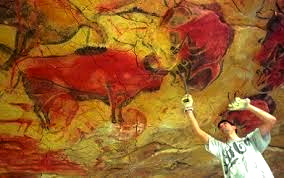
Human occupation was limited to the cave mouth, although paintings were created throughout the length of the cave. The artists used charcoal and ochre or haematite to create the images, often diluting these pigments to produce variations in intensity and creating an impression of chiaroscuro. They also exploited the natural contours in the cave walls to give their subjects a three-dimensional effect. The Polychrome Ceiling is the most impressive feature of the cave, depicting a herd of extinct steppe bison (Bison priscus) in different poses, two horses, a large doe, and possibly a wild boar.

Dated to the Magdelenean occupation, these paintings include abstract shapes in addition to animal subjects. Solutrean paintings include images of horses and goats, as well as handprints that were created when artists placed their hands on the cave wall and blew pigment over them to leave a negative image. Numerous other caves in northern Spain contain Paleolithic art, but none is as complex or well-populated as Altamira.” – WIKIPEDIA

For more information please visit WIKIPEDIA: http://en.wikipedia.org/wiki/Cave_of_Altamira

Mother & Daughter Camino – Grazyna & Beata

1010638_485806291488075_705559816_n
It is always a very special experience for me to hear of pilgrims stories – the WHY’s, WHAT’s, WHEN & HOW’s of their Camino Journey.  I am always touched, moved and grateful for the sharing that occurs as it is inspiring and continually transformational.
It was a wonderful surprise to receive Beata Moritz’s email as I had been meaning to email those involved in the Rexistro 108 Vilei Global Pilgrims Photography & Video Project.  For German and I this is a fun  experience inspired by his creating the photography project in August 2011.  We when time permits take pictures and video at his families historic 150 + year old country house located 108 KM to Santiago de Compostela.  But as “synchronicity” and luck would have it I emailed Grazyna Boszko, Beata’s mother, on just the right day for Beata was traveling to Santiago 4 days later, June 5, and would arrive when we were setting up the exhibition in the Parador and participating as the inauguration event for the 1st Camino Film & Television Festival.
We loved receiving Beata’s email with the story and pictures of their Camino.  We enjoy seeing the pilgrims in their everyday lives and the pictures in the Camino.  It is wonderful to see the combination and also to hear how again and again the Camino calls to ALL.  It is truly something that transforms and keeps you wanting to return again and again for another Camino Journey Experience!  Wishing Beata all the best as she plans her next Camino – Two this year – so very special! Thank you Grazyna and Beata for sharing with us your story and some of your pictures.
IMG_4199
Dear Susan,
Thanks for the mail.
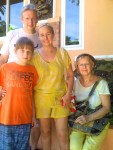
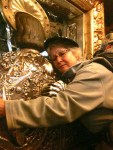
My name is Beata and I went the camino last year with my mum.
Her name is Grazyna Boszko , she is 63 years old.
My mum lives in Poland in the city  Makow Mazowiecki ( I live in Germany with my husband and son 10 j).
You make a picture of me to!
We started the camino sant jean pied de port.
Experiences: my mum have from logrono to Santiago shiver on the whole body when she prayed to the st. Jacobus and the shiver was the answer!
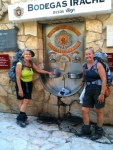
I attached pictures of my mum and me and my family .
My husband went the camino France’s 2x, portuges1x and in September 2013 via plata,  me – France’s 2x, mother France’s 1x
We walk the way every year.we love Spain , the Spanish people , the camino!!!!
Everybody say: ” if you want to go the camino- you recived  what you need ( want!)”!!! It is TRUTH!!!
You send the mail to me today and I fly to Santiago on 5.6.13. ! Next week!!!
And your photography exhibition is in parador on 5.6.! It’s perfect! I have a Facebook site : Beata Moritz ( krefeld/maków Mazowiecki ).please send me a picture of me .
Thx Beata Moritz
Mit freundlichen Grüssen Beata Moritz

Serdecznie pozdrawiam Beata Moritz

Cigüeña’s Along The Camino

123920-826-549

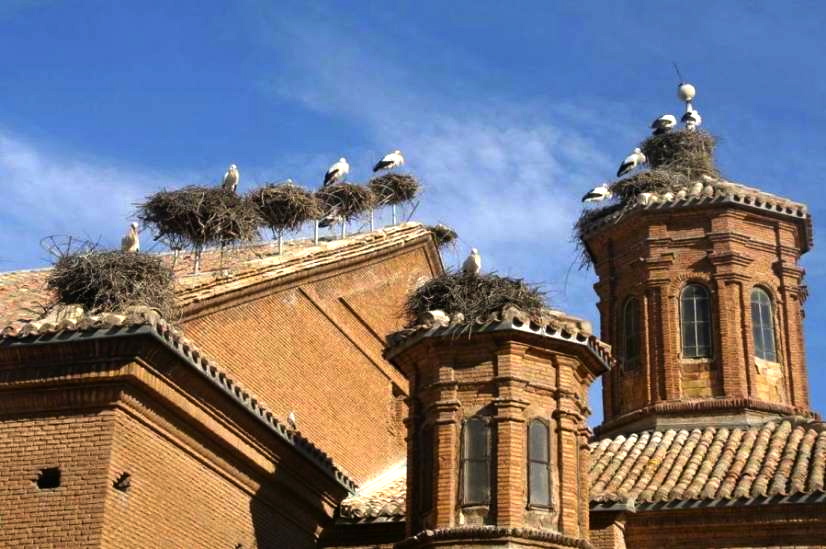
Seeing Cigüeña’s, Storks, Along The Camino is a very unique and interesting experience.  I remember as I first began to see from a distance large nests on top of light posts and churches that made me wonder what could that be.  My friends quickly educated me on the cigüeña’s or storks that make these high locations their home.  Perfect perches for them to look out across the landscape.  It is always fun to see where they will make their nest and how many there will be as they dot the roads and small villages along the camino saying hello to all those who pass by.

“The ciconiformes (Ciconiiformes) are an order of birds neognatas whose amplitude and composition has been widely discussed for years. Recent developments suggest that only taxonomic should include family stork . The cicónidos commonly known as storks. They are long-necked birds, waders and waterfowl that inhabit warm temperate regions of the world. Their diet consists of frogs , fish and small birds or mammals .

Are mainly distributed in Europe , Asia and Africa , with only 3 species in America .” – WIKIPEDIA

Thank you 20 Minutes.es for your great picture in La Rioja: http://www.20minutos.es/noticia/1829250/0/rioja-baja/pera/rincon-soto/

Thank you Cazaworld.com for your fantastic cigüeña picture: http://cazaworld.com/blog/los-ecologistas-se-rien-de-la-acusacion-de-los-cazadores/

Muchisimas Gracias Parador Hostal Dos Reis Catolicos

Flyer

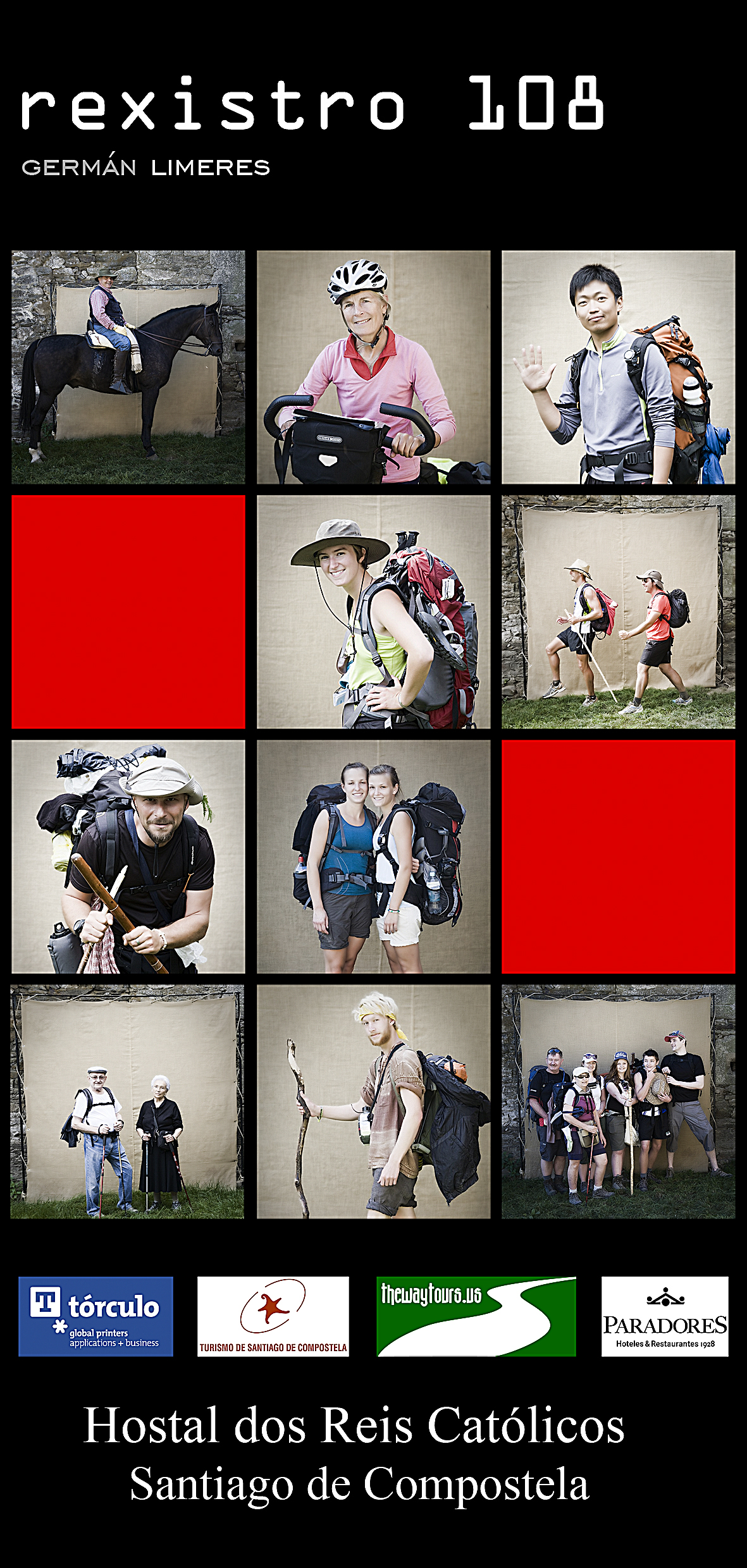
German Limeres and I would like to thank everyone that made this years Rexistro 108 Vilei Global Pilgrims’ Photography & Video Exhibition in Santiago de Compostela possible.  A very special thank you to Julio Castro Marcote, Director of Parador Hostal Dos Reis Catolicos, for making the exhibition this June and July 2013 available to share with the pilgrims and tourists visiting the city. It was time yesterday to take down the exhibition that we were so fortunate to share for two months with pilgrims and visitors to Santiago.  A celebration we hope to have the opportunity to share in again next year in 2014.

The exhibition is a dream come true for me as this special event was inspired three years ago, one year before meeting German, when I attended and met Christina Oiticica and Paulo Coelho at their special private party event celebrating Christina’s Art Exhibition during Xacobeo July 2010.  Paulo was very kind to personally introduce me to Julio Castro, and I knew that someday I wanted to share with others more of the Camino spirit and inspiration that it has provided in my life with others.  I am very grateful to German for sharing his passion of Galicia, the Camino and Pilgrims with me that has provided for so many incredible experiences in Galicia.  I have gotten to truly live more of the Camino and pilgrimage spirit for which I will be forever grateful.

This journey has shown me that you never know what will come from meeting people and where it will lead but that there is OPPORTUNITY and INSPIRATION waiting for us to CONNECT and SHARE using our gifts and talents working collaboratively with others to make a difference in the world.

We are excited to continue this journey as the exhibition moves onto Samos Monastery later this August and September connecting with more pilgrims and visitors along the Camino Frances.  We look forward to sharing it with others as it begins to make its way around the world inviting others to make their own pilgrimage journey.

JULIO CASTRO MARCOTE – DIRECTOR OF PARADOR HOSTAL DOS REIS CATOLICOS VIDEO LINK:

We would like to thank everyone who made the exhibition possible: Julio Castro Marcote, (Director of the Parador Hostal Dos Reis Catolicos), Dimas Gonzalez (Film Commissioner, Santiago de Compostela), Nazareth Martín (Director Of The Camino Film & Television Festival), Martin Cañedo, Maruxa Ledo (Director Of Turismo de Santiago de Compostela), Tórculo Printing, Imaxina Diseño Begoña, Jaime, Jorge Diaz Luque, Stacy Elain Lutsch (Friend, Translator, and Fellow Pilgrim), Marisa Granda Escudero (Friend and Fellow Pilgrim), and a very special thank you to German Limeres for his wonderful photographs of the pilgrims and creating Rexistro 108 Vilei sharing the inspiring faces and stories with others.

40 Shades Of Green – Sylvie Sims Shares Camino In Ireland

photo


When I heard my Camino Friend Sylvie say “40 SHADES OF GREEN” a wonderful feeling came over me.  Beautiful images filled my mind and my spirit was swept away with all the wonderful possibilities of a magical adventure.  I wanted to learn more and see what the 40 Shades Of Green is like.  This fantastic picture of Ireland reminds me of the beauty of Galicia and inspires my Camino Spirit – thank you Sylvie for sharing and inspiring more Camino adventures!

Hi Susan today Oliver and I did a track it was a place called keeper hill, the walk was 17 kilometre and so beautiful I think from the photo you can see a couple of the 40 shades of green. There is a pilgrim walk that thousands do every year here in Ireland it’s called Croke Patrick, it’s quite a challenge but there is a reward when you reach the summit,looking down over clue bay with its 52 islands, it’s truly a most wonderful sight”.

“I have journeyed far and wide, seen some truly wonderful sights but my heart always fills with delight when I return home to the emerald isle with its 40 shades of green”.  – Sylvie Sims


COMPOSTELA – “Field Of Stars” – August 10 -13!

1098067_500710390011658_1612805806_n


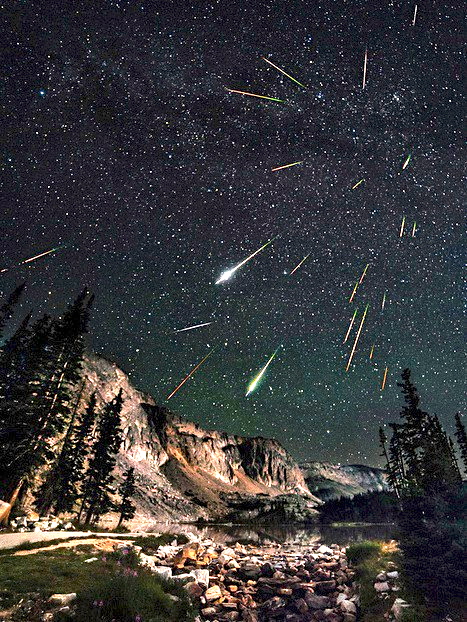
One of the very special experiences of the Camino is the time in nature enjoying its beauty at all different times of the day and night. This August 10 – 13 there will be a very special opportunity to experience the nights sky and It brings home to our heart the meaning of “Compostela” which its name comes from the Latin Campus Stellae – “field of the star”. Hope you enjoy wherever you are!


“During the nights from August 10 – 13, 2013 People on Earth will have a chance to see one of the rarest meteor showers. During the night you will be able to see thousands of these falling stars until August 13, these meteors will have the best visibility during the night of Aust 12, 2013. There is a predicted number of about 50 – 100 meteors an hour.” –  Rob Saunder’s

“Gear up to see some great balls of fire streaking through the sky this month. According to NASA research, the upcoming Perseid meteor shower produces more meteors than any other annual shower, earning it the title of “fireball champion.”  – Milky Way Scientists

http://oak.ctx.ly/r/97e1

You may enjoy checking out Milky Way Scientists for more beautiful pictures and interesting information: https://www.facebook.com/Milkyway.Nasa.115943216485228220871

Thank you Terrie Marie for sharing Rob Saunder’s photo and others that posted some great information for us to keep an eye out for our “Field of Stars”.

A Little Galician Gaita Music To Inspire A Camino Spirit

galician_bagpipe_large

The music of Galicia is inspiring and blends ancient cultures and historic traditions. The Galician Gaita – bagpipe – immediately makes you feel like a “time traveler” and your mind is filled with many beautiful images of nature, magical forests, town festivals and so much more.  As you listen it makes you want to dance and share in the magic of the moment.

The Camino spirit is alive in all the festivals of Galicia – celebrating their rich, vibrant and alive culture. When visiting any of the fantastic Galician Festivals you feel immersed in the traditions and history that makes Galicia so unique!

We had a great time traveling from one festival to another and it was a very special day where we experience 3 very different Galician celebrations.  We ended the day with Festival de Pardiñas with a little “barbecoa” (BBQ) and live music Galician Style!

SUSANA SEIVANE – GALICIAN GAITA – Festival de Pardiñas August 4, 2013

“The Galician gaita or gaita de foles is a traditional bagpipe of Galicia and is very similar to those of Asturias and northern Portugal.

The word gaita is used across northern Spain as a generic term for “bagpipe”, although in the south of Spain and Portugal it denotes a variety of horn, flute or oboe like instruments according to region.

Suggestions as to the origin of the name gaita are many. It has been compared to the names of eastern European bagpipes, such as gaidagajda, and gajdy. The linguist Joan Coromines has suggested that the word gaita most likely derived from a Gothic word gait or gata, meaning “goat”; as the bag of a gaita is made from a whole, case-skinned goat hide. Gothic was spoken in Spain from the sixth century to the eighth century when the country was ruled by theVisigoths. The Visigoths originated in eastern Europe.” – WIKIPEDIA

Spanish is Yoga for the “Boca”

1010252_409804239139192_2121098508_n


Spanish is a language I LOVE to listen to. It is like a dance that is shared as it rolls off the tongues of many spaniards as they converse with friends and family.  It is a language of connection, ancient traditions, customs and of rich cultural heritage.  As I continue to learn more spanish little by little I have often thought and said that ‘Spanish is YOGA for the BOCA’! It challenges your mind and your mouth (boca) to work towards making your own dance of words.  My “spanglish” is far from the fluid flow of a smooth “yoga sun salutation” or in this case “sunset salutation” but I will keep at it – just like the Camino it is the journey not the completion.

First we will keep at spanish so wishing everyone Buen Camino – and someday maybe I will know a little more Gallego – so Bo Camiño!